what two methods are used to classify hurricacnes
Classifying Tropical Cyclones
When you lot've finished this department, you should be able to discuss classification schemes for tropical cyclones, including associating the proper criteria and thresholds for the terms hurricane, tropical tempest, tropical depression, draft, and super typhoon. You lot should too able to depict the Saffir-Simpson scale and define the term subtropical cyclone.
Although I imagine most everyone is familiar with the term "hurricane", before we study the basics and bolts of these storms, nosotros've got to encompass some terminology that helps scientists (and the public) classify tropical cyclones. Afterwards all, not all tropical cyclones are hurricanes! For starters, formally, a tropical cyclone is the generic proper noun given to low-pressure systems that form over warm tropical or subtropical seas.
As I mentioned previously, tropical cyclones are meteorologically dissimilar than the mid-latitude cyclones (also chosen "extratropical cyclones") that you learned about earlier. For starters, tropical cyclones accept a "warm cadre," meaning that temperatures throughout near of the troposphere are higher at the center of a tropical cyclone compared to its surroundings. Mid-breadth cyclones, on the other hand, are "common cold cadre." Another large difference is that mid-latitude cyclones rely on the presence of big temperature gradients to strengthen (mid-breadth cyclones are associated with fronts). Tropical cyclones, conversely, normally class in environments with minor temperature gradients (in other words, environments without fronts).
Instead of relying on large temperature gradients, organized thunderstorms effectually the middle of a tropical cyclone are central to its livelihood (for reasons we'll investigate later in the lesson). Mid-latitude cyclones, on the other hand, often take thunderstorms well displaced from their centers (if they take any thunderstorms associated with them at all). This difference leads well-developed tropical cyclones and mid-breadth cyclones to announced very differently on satellite imagery. For example, cheque out this color-enhanced h2o vapor loop from July 9, 2018. The loop shows two cyclones marked by distinct counterclockwise swirls. The whirlwind closer to the U.S. coast a tropical cyclone (Tropical Storm Chris), which has lots of tall, thunderstorm clouds near its center. The cyclone farther northeast is a mid-breadth cyclone, which lacks thunderstorms near its center. The side-by-side visible satellite images beneath also highlight the visual contrasts between tropical and mid-breadth cyclones. On the left, a large mid-latitude cyclone centered near Lake Michigan demonstrated a familiar comma shape on May xi, 2003, thank you to the conveyor-belts and fronts that you learned about previously. On the right, withal, Hurricane Rita lacks the comma shape of a mid-breadth cyclone, and has thick, tall thunderstorm clouds surrounding its center.
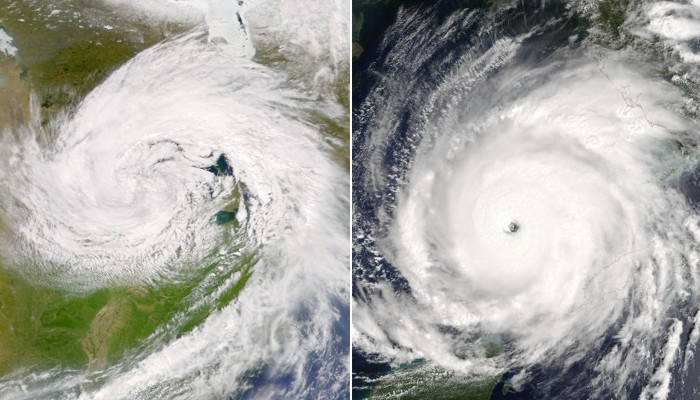
(Left) A large, sprawling mid-breadth cyclone centered near Lake Michigan demonstrated a familiar comma shape on this visible satellite prototype from May 11, 2003. (Correct) Hurricane Rita (approaching Category v status) at 1610Z on September 21, 2005, lacked the well-defined comma shape of a mid-breadth whirlwind. The visual differences of these ii storms provide a clue that mid-breadth and tropical cyclones operate a chip differently.
Credit: NASA
The visual differences between mid-latitude and tropical cyclones provide a clue that they operate a bit differently, and we'll see how as the lesson unfolds. But, beginning, let's suspension down the types of tropical cyclones to see how meteorologists allocate and keep track of them. For starters, forecasters often accept their optics on clusters of showers and thunderstorms across the tropics (frequently called "tropical disturbances"). Tropical disturbances do non accept airtight circulations and are not formally tropical cyclones; however, past convention in the U.S., tropical disturbances that have the potential to develop into tropical cyclones are dubbed "invests." But, if a tropical disturbance with organized thunderstorms develops a closed apportionment around its surface center of depression pressure (counterclockwise in the Northern Hemisphere; clockwise in the Southern Hemisphere), a tropical cyclone is built-in! Meteorologists then utilize the following labels to classify the cyclone:
- Tropical Depression: a tropical whirlwind with maximum sustained wind speeds less than 34 knots (39 miles per hr). "Sustained" is a key discussion there because definitions of what a "sustained" wind is vary across the globe (information technology could mean anywhere from a 1-minute average wind speed to a ten-minute average wind speed). Then, classifications of tropical cyclones can vary across the globe based on unlike definitions of "sustained." Besides annotation that to be classified as a tropical depression, a tropical disturbance must develop a closed surface circulation, organized thunderstorms, and air current speeds less than 34 knots (39 miles per 60 minutes).
- Tropical Storm: a tropical cyclone with maximum sustained current of air speeds of at least 34 knots (39 miles per hour). When a tropical tempest is identified, information technology formally receives a name (we'll talk more virtually naming conventions later in the lesson). Tropical cyclones retain their tropical tempest status as long as their maximum sustained winds remain between 34 knots and 63 knots.
- Hurricane: a tropical cyclone with maximum sustained winds of at least 64 knots (74 miles per hr).
Typically, a developing tropical cyclone will evolve from a tropical low to a tropical storm earlier becoming a hurricane (if atmospheric condition are favorable for strengthening). It's of import to annotation that tropical cyclones are classified past their maximum sustained wind speed (an average current of air over a length of time ranging from 1 to 10 minutes, depending on the region of the globe). They are not classified past maximum wind gusts (brusk bursts of wind lasting a few seconds). The near intense tropical cyclones are called hurricanes, but they only become by that name in some parts of the world (including the United States). Indeed, in other parts of the world, tropical cyclones go by other names. For example, in the Northwest Pacific Ocean, forecasters use the word draft instead of hurricane. In parts of the Indian Ocean, such storms are called "severe cyclonic storms," while in other parts of the Indian Ocean, they're chosen "severe tropical cyclones." So, don't be confused when y'all hear a terms like typhoon, severe cyclonic storm, or severe tropical whirlwind. They all describe storms that are the same equally hurricanes (tropical cyclones with maximum sustained winds of at least 64 knots).
At times, I may generically refer to "hurricanes," but keep in mind that such references also include strong tropical cyclones that get by diverse labels in ocean basins around the world. Of course, all "strong" tropical cyclones (hurricanes, typhoons, etc.) are not created equal. Some are much more than intense than others. In the Atlantic and Northeast Pacific basins, forecasters employ the Saffir-Simpson Hurricane Wind Scale to further classify a given hurricane. Hurricanes classified as Category iii, Category 4, or Category five (all hurricanes with maximum sustained winds of at least 96 knots, or 111 mph) qualify equally major hurricanes.
| Category | Maximum Sustained Wind | Clarification |
|---|---|---|
| 1 | 64-82 knots (74-95 mph) | Small current of air harm (to roofs, shingles, siding, gutters, large tree branches, etc.). Impairment to power lines and poles may result in power outages that could last several days. |
| 2 | 83-95 knots (96-110 mph) | Extensive wind damage (major roof and siding damage, shallow-rooted trees snapped or uprooted). Power outages may last several days to weeks. |
| 3 | 96-112 knots (111-129 mph) | Devastating wind damage (major harm to, or complete loss of roofs, many copse snapped or uprooted). Electricity and water likely unavailable for several days to weeks. |
| 4 | 113-136 knots (130-156 mph) | Catastrophic wind harm (complete loss of roofs and major damage to exterior walls of some homes, about trees snapped or uprooted and power poles downed). Power outages may last weeks or months, making hardest-hit areas uninhabitable. |
| 5 | 137+ knots (157+ mph) | Catastrophic wind damage (a loftier percentage of framed homes destroyed, residential areas isolated by fallen trees and ability poles). Power outages will terminal for weeks or months, making hardest-hit areas uninhabitable. |
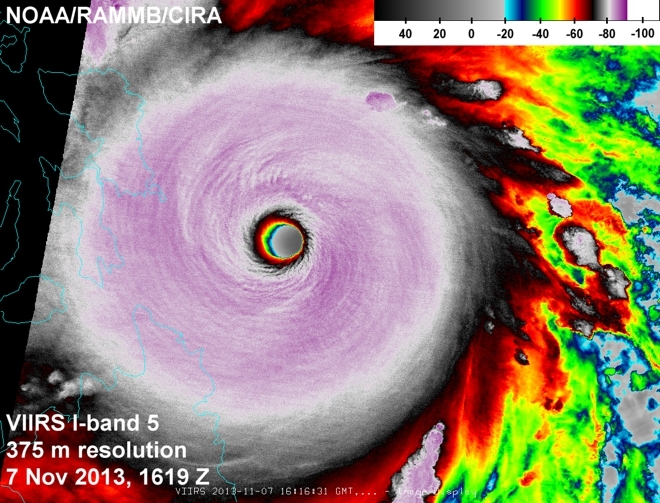
High-resolution enhanced infrared satellite prototype of Super Typhoon Haiyan before its landfall in the Philippines. At landfall, Haiyan had maximum sustained winds of 195 mph.
Credit: NOAA / RAMMB / CIRA
Although major hurricanes make upwards only 21 percent of the hurricanes that hit the United States, these vehement storms business relationship for over 83 percent of all the damage from landfalling hurricanes. Other ocean basins also have dissimilar descriptors for extremely intense tropical cyclones. In the Northwest Pacific Basin, for example, the particularly descriptive classification of "super typhoon" is used once a typhoon'southward maximum sustained wind speed reaches at least 130 knots (more than twice the minimum wind-speed criteria for a typhoon). Super typhoons are the equivalent of a at least a high-finish Category 4 hurricane on the Saffir-Simpson Scale.
Like the basic nomenclature scheme for tropical cyclones (tropical low, tropical storm, hurricane), the categories of the Saffir-Simpson Calibration and other descriptors like "major hurricane" and "super draft" are all based on the maximum sustained air current speed within the storm. These winds are usually confined to a relatively pocket-size expanse of the storm somewhere most the heart, so the types of current of air damage described by, say, a Category three hurricane on the Saffir-Simpson Scale, typically occur just in areas that take a "straight striking" from the storm (the center passes nearby). Areas further from the center may also experience wind harm, merely it'south typically less severe than what's described by the storm'due south Saffir-Simpson rating. Winds, all the same, are just 1 hazard posed by tropical cyclones. Indeed, a tropical whirlwind need not even reach hurricane status to cause devastating effects (flooding in southeast Texas from Tropical Storm Allison in 2001 is a prime instance). So, just considering a tropical cyclone doesn't accept strong plenty winds to be a hurricane doesn't mean it can't be catastrophic!
You too may accept heard of another storm classification, chosen a subtropical whirlwind, which is a "hybrid storm" of sorts. A subtropical cyclone has characteristics of both tropical cyclones and mid-latitude cyclones, meaning that information technology may have a warm core through a minor part of the troposphere just while existence embedded in a region of large temperature gradients. So, you may hear meteorologists apply the terms "subtropical low" or "subtropical storm" to describe these hybrids. Such classifications assistance meteorologists diagnose a storm's structure and keep historical records, but most people might not notice a divergence in impacts betwixt, say, a subtropical depression and a tropical depression (their weather condition impacts would be similar). In case you're wondering, subtropical cyclones can transition into tropical cyclones if they can fully develop a warm cadre and organized thunderstorms around their eye, and exit regions of large temperature gradients.
Now that we've covered some basic terms and classifications, we're going to talk about the climatology of tropical cyclones. In detail, nosotros'll focus on where, when, and why they tend to form effectually the earth. Read on.
Source: https://www.e-education.psu.edu/meteo3/l12_p2.html

Postar um comentário for "what two methods are used to classify hurricacnes"