Upload New Version to Amazon Developer Console
Step 7: Upload App Files (APK Files)
The documentation here relates to the APK Files tab:

On the APK Files tab, you upload your APK files, indicate which devices your APKs support, and more than. For more conceptual topics related to APKs, run across the following:
- Preparing the APK File for Your App: Provides data about preparing your APK and the code wrapper that Amazon uses with your APK, likewise as APK size limitations and other details.
- Device Filtering and Compatibility: Explains how attributes in your manifest determine the devices your APK supports.
(If you lot're uploading a web app, come across Upload Web App Files instead of this topic.)
- APK Files Fields
- Public Cardinal and PEM File
- Appstore Certificate Hashes
- Update an Existing APK
- Adjust Device Support for Your APK
- Add Multiple APKs for the Same App
- Troubleshooting Common Errors
- Fault: Duplicate bundle name
- Alert: Reduced device support
- Target device not available
- Targeted by another binary in the current version
- Next Steps
APK Files Fields
The following table describes each field and section on the APK Files tab.
| Field | Description |
|---|---|
| Use Amazon DRM? | For each app that you submit to Amazon (a unmarried app might contain multiple APKs), you can choose either to apply DRM or make your app available without any rights direction constraints. DRM (digital rights management) protects your app from unauthorized use. The DRM setting applies to all of your app'south APKs. Without DRM, your app can be used without restrictions past whatever user. If y'all choose to employ DRM to 1 of your apps, you must utilise the DRM arrangement provided by Amazon through the Developer Portal. Annotation that the DRM setting applies to all of your app's APKs. If yous have previous APKs uploaded and are adding a new APK with unlike DRM settings than your previous APKs, yous'll demand to replace the previous APKs besides so they can receive the updated DRM settings. Otherwise, your previous APKs will retain the same DRM settings as earlier, regardless of your selection here. Run into Near DRM for more information. |
| APK File | Upload your Android APK files (driblet one file at a fourth dimension into the box). If didn't use Android Studio to build your signed APK, y'all might demand to zipalign your file. When you add together an APK file, you lot can see its details by clicking the data icon 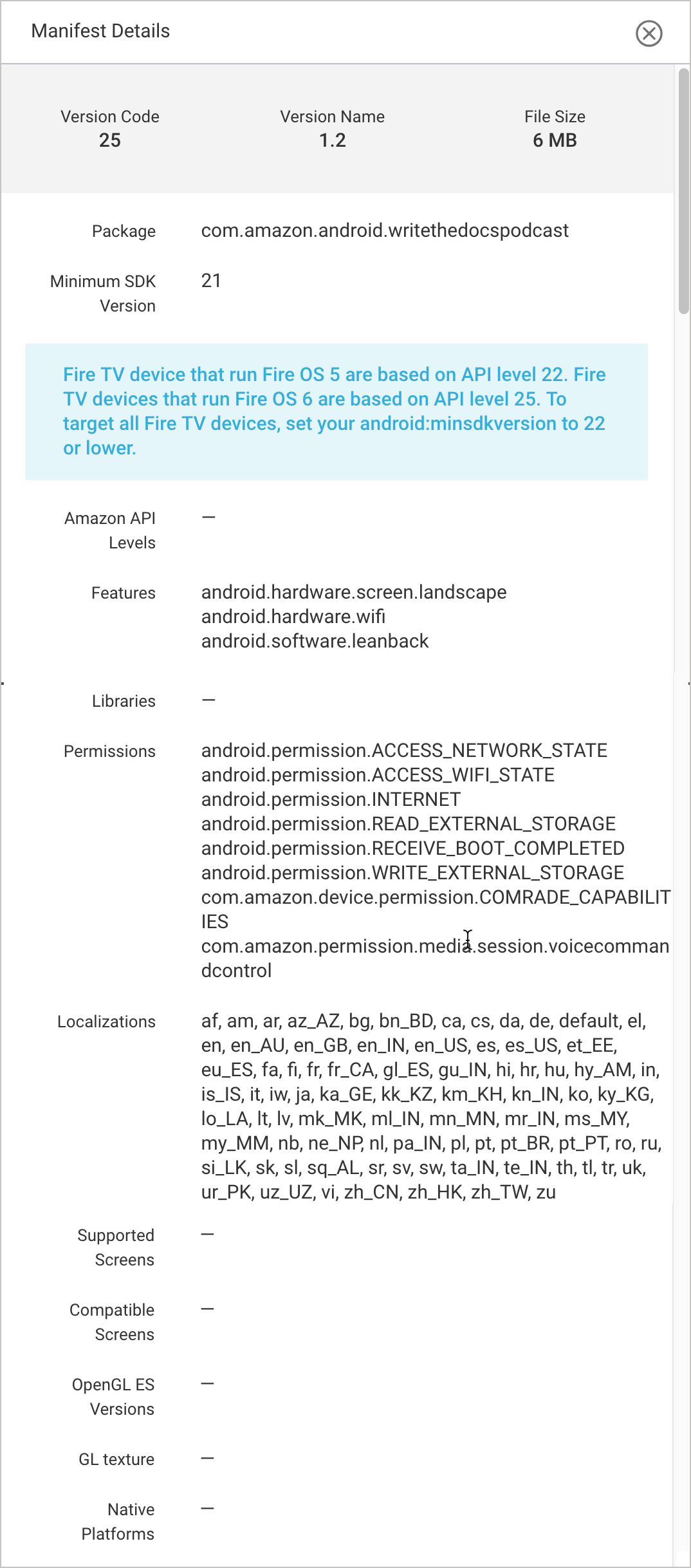 After you upload an APK, the APK receives an alias named later the API level (for example, "apilevel22"). You tin rename the alias equally desired. The custom allonym is used internally and not be seen past customers. See Preparing the APK File for Your App and Updating a Published App for more details related to APK files. |
| Language Back up | Select at least one language supported by your APK. Your choice here appears in a "Supported Languages" section in the device app details page in the Appstore to let users know which language is available in the app. (The "Supported Languages" section appears merely on the device's display of Appstore apps, not on the Amazon Appstore website.) The Language Support selection hither doesn't influence whether your app becomes available in localized Appstore marketplaces. Whatever localization interfaces in your APK must be handled by your APK itself, non through settings in the Appstore submission process. However, if you do have a localized APK, y'all can add localized descriptions and image assets. The descriptions, paradigm avails, and linguistic communication support option selected here all inform your app details page in the Amazon Appstore. Come across Distribute Your App Internationally for more details on localization. |
| Testing Instructions | Use this field to communicate with the Amazon testing team. (If no testing instructions are needed, leave this field blank.) Testing instructions might include the following —
|
| Export Compliance | Asks you to certify that your app is compliant in all countries in which you've called to make it bachelor. Y'all can read more details in the "Compliance with Laws; Privacy and Security Obligations" section in the Amazon Developer Services Agreement |
| Employ Amazon Maps Redirection | Allows you to automatically redirect Google Maps v1 API calls from your app to the Amazon Maps API. Only used in tablet and telephone apps if you accept the Google Maps API implemented. |
 . These details include the version lawmaking, version proper name, file size, package name, minimum SDK version, features, libraries, permissions, localizations, supported screens, compatible screens, OpenGL details, and native platforms. For example:
 Public Key and PEM File
In the upper-right area of the tab, at that place is a link for a Public Key. This public key, which is unique per app, establishes a secure communication channel betwixt the Amazon Appstore and your app. When yous generate the public key from the Developer Console, Amazon generates a corresponding private fundamental. These public and private keys class a key pair to sign license responses. Through this key pairing, yous ensure that the users who install your app are authorized.
The public key is stored in a PEM file. If your app uses the Appstore SDK or the Appstore SDK plugin for Unity for In-App Purchasing (IAP) or DRM, you must add together the PEM file to your project. To configure your app with the public cardinal:
- Click Public Key.
-
In the Public Key dialog box that appears, click the AppstoreAuthenticationKey.pem link to download the PEM file.

PEM file link - Copy the AppstoreAuthenticationKey.pem file.
-
Follow the instructions for your project type.
Android project instructions
- Paste the PEM file into the app/src/main/assets binder of your Android Studio projection.
- In the Project view, the assets folder is commonly in app/src/main/assets. If your app doesn't have an assets folder, you must create one. And so drag your PEM file into it.
Unity project instructions
- In the Assets binder of your project, create a new folder named StreamingAssets.
- Paste the PEM file in your Avails/StreamingAssets folder.
For more than details, see Configure Appstore SDK with your public key or Configure Unity App with Public Key.
Appstore Certificate Hashes
Certificate information, which includes the SHA-1, MD5, and SHA-256 hashes, is available from a link in the upper-right surface area of the tab. As office of the ingestion process, Amazon removes your developer signature and applies an Amazon signature. This signature is unique to y'all, does non change, and is the same for all apps in your account. For more details, run into Amazon App Signatures.
Update an Existing APK
If you're updating an existing APK, see Updating a Published App. When you make the update, you have the option of replacing an existing APK and retaining the aforementioned Device Support selections, or removing the previous APK and re-selecting your Device Support details.
Adapt Device Support for Your APK
Afterward you upload your APK, the number of supported devices appears in the Uploaded APKs section.

To manage which devices your APK supports, select Edit next to the number of supported devices. In the Device Support overlay, devices with an 'Ten' adjacent to their name are unsupported. Unsupported devices are determined past the attributes in your manifest and the countries yous targeted in Pace 3: Add Availability & Pricing.
To empathise why a device isn't supported by your APK, movement your mouse over the help icon  next to the device proper name in the Device Support dialog box, equally shown in the post-obit image.
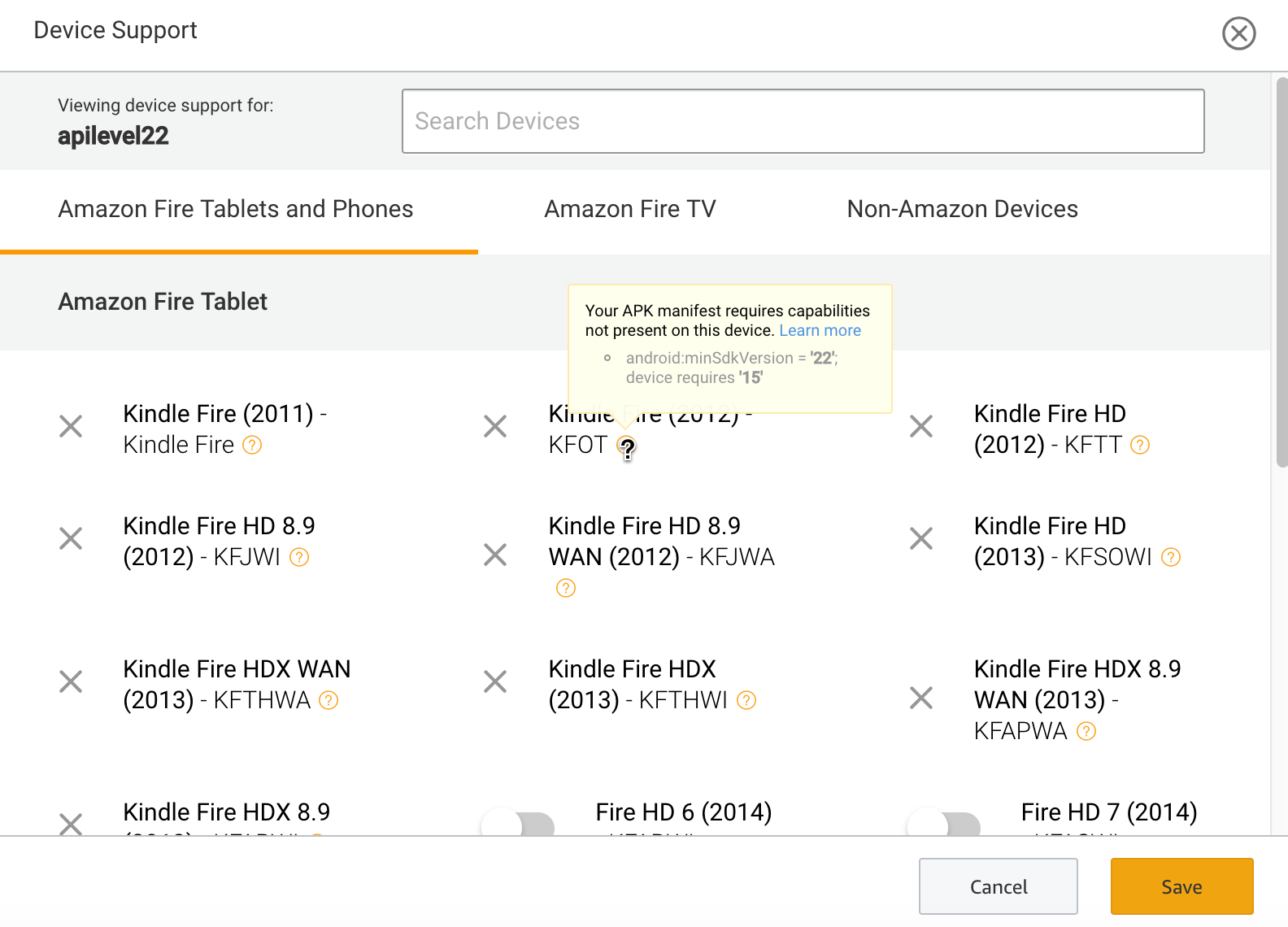
If necessary, y'all can manually remove support for devices that have known compatibility issues. The supported devices are grouped into 3 categories:
- Amazon Fire phones and tablets: Shows the Fire phones and tablet support for your app. Come across the Tablet Device Specifications for more details. Past default, device support for your uploaded APK is turned on for all Amazon Fire Phone and Fire tablet devices, and for all non-Amazon Android devices.
-
Amazon Burn Telly devices: Shows the Fire Telly device back up for your app. For details on Burn down TV device names, see Burn Telly naming conventions; for specifications, encounter Device Specifications for Burn Idiot box.
- Not-Amazon Android devices: Shows Android devices on which your app could exist installed through the Amazon Appstore for Android app. The Amazon Appstore supports non-Amazon devices running Android 5.0 and above. This option provides additional distribution avenues for your app (and is peculiarly helpful if your app is only bachelor in the Amazon Appstore, not on Google Play). Within this non-Amazon Android devices grouping, devices are sorted into three groups: Supported (compatible), Excluded (manually de-selected), and Unsupported (incompatible based on your manifest settings).
To adjust which devices are supported by your app, click Edit device support and update the devices indicated. Toggle device back up on (green) or off (grayness) as advisable. Use the tabs at the summit of the dialog to move between categories.
For example, if you're uploading a streaming media app designed for Fire TV devices, click Edit device support on the Amazon Fire Television receiver devices row and select the advisable device support options on the Amazon Fire TV tab:

For additional information about supported devices for your APK, run across the following:
- Troubleshooting Android Manifest and Device Filtering
- Device Filtering and Compatibility
- Supported Filters on the Amazon Appstore.
For non-Amazon devices, at the bottom of the Device Support dialog, at that place's an pick for All other Android devices. The Non-Amazon Android devices can be toggled on or off as a whole, or you can manually adapt device back up. This setting allows your app to be distributed to any other Android devices, including future uniform Android devices. New devices are added regularly based on device popularity. Through manifest filtering, the Appstore automatically determines the device's compatibility.
If you turn off "All other Android devices," you lot alter your compatibility strategy from using a deny list to using an allow list for non-Amazon devices. In other words, your APK won't exist compatible by default on those devices; instead, you'll need to manually select which 3rd-political party devices your APK volition back up.
To add an additional APK for the same app, see the next section, Add Multiple APKs for the Same App.
Add Multiple APKs for the Same App
When uploading multiple APKs, make certain each APK has the same package proper name in the manifest; however, each individual APK should accept a unique versionCode in your Gradle build file.
When you lot add multiple APKs, because each APK can only be available for a single device, you have to remove support for devices from your first APK that you want to be available for the additional APKs. The following step-past-pace instructions and screenshots volition clarify this selection process.
To upload multiple APKs:
- If you haven't already uploaded your first APK, upload it by dragging the APK into the APK Files box.
-
For the first APK you uploaded, next to "Supported Devices," click Edit and remove back up for devices that you plan to target with your second APK.
For case, suppose yous have two APKs for your Fire TV app — "APK1" and "APK2". With APK1, you want to target all Burn TV devices except Fire TV (iiird Gen). For APK1, click Edit next to "Supported Devices" in the APK File department. In the Device Back up dialog box that appears, articulate the checkbox adjacent to "Fire Idiot box (3rd Gen)." This will make Fire Television (3rd Gen) bachelor for APK2 to target. If you don't remove the device back up from the first APK, you lot won't be able to target information technology with the second APK.
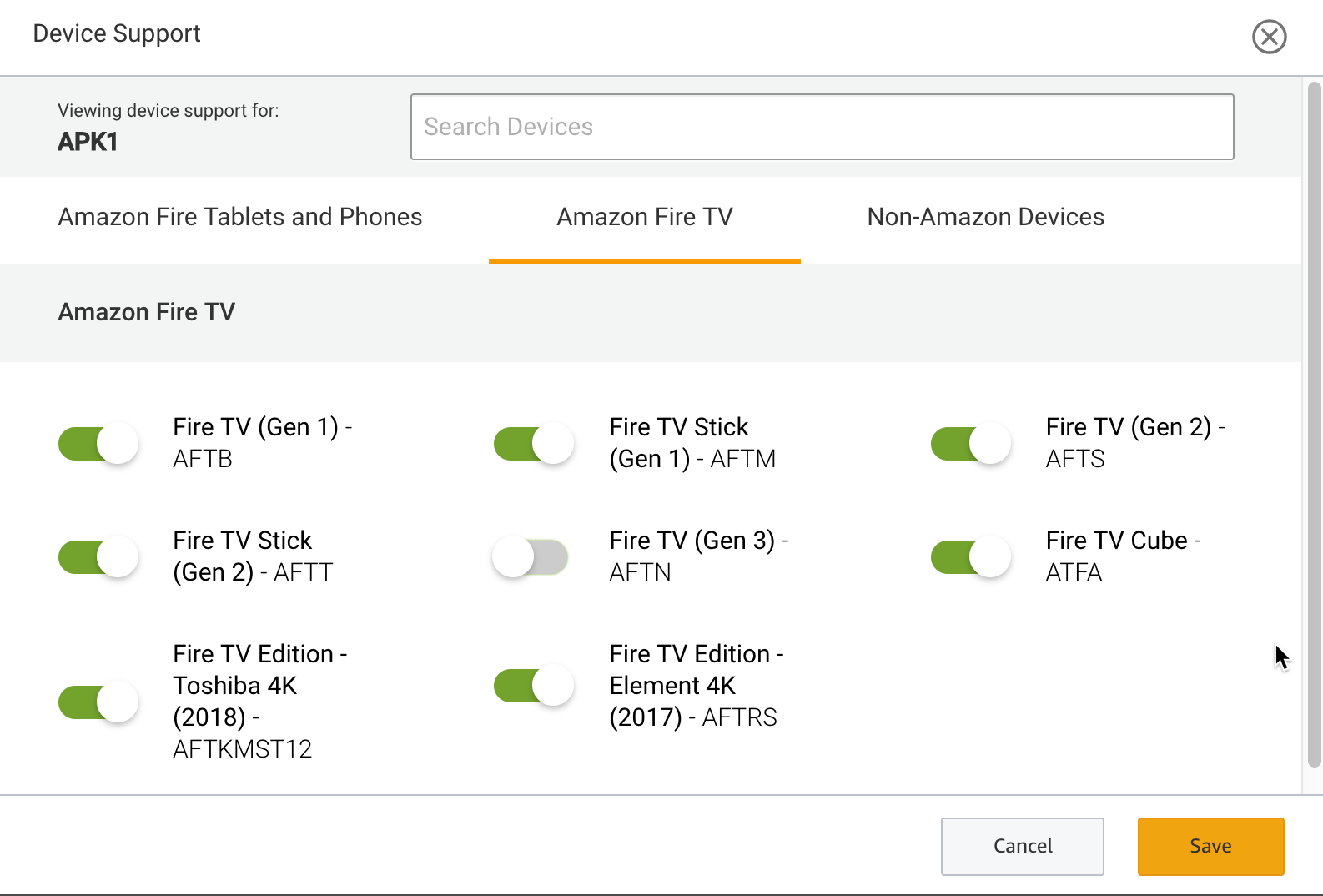
In this scenario, we removed back up for Burn Television set (3rd Gen) because we want to select it with our 2d APK Annotation that if you're updating an existing APK, when you clear the checkbox next to some supported devices, you may run into a "Reduced device support" alarm. This warning lets you know that you're shrinking the number of supported devices for your app. Customers who previously installed your app on those devices (now unsupported by this APK) won't get the update. (You can read more in Alert: Reduced device support.) Since you're uploading multiple APKs, you tin disregard this notice. Afterwards you upload some other APK and target these devices removed from your outset APK, the alert will no longer be applicable.
- (Optional) Give your APK a recognizable alias to distinguish it from the adjacent APK you upload.
-
Drag some other APK file into the APK Files box. Optionally, alter the alias for the new APK you uploaded to distinguish it from the first APK.
When you drag another APK into the APK Files tab, the devices supported by the offset APK are unavailable for the 2d APK — because two APKs can't be installed on the same device. Under the greyed-out devices, you should see the phrase "Targeted by another APK in the electric current version." ("Targeted" just means that you selected support for the device with your app.) Retrieve this rule: Multiple APKs cannot be installed on the aforementioned device. With the second APK, y'all can select back up for devices not already selected past the first APK.
Continuing with our previous example, suppose y'all upload "APK2" and want Fire TV (3rd Gen) to support this APK. You already cleared support for this device with the previous APK, and then it should at present be selectable with this second APK.

Fire TV (3rd Gen) can exist selected considering you didn't already select support for it with the previous APK. The other devices take a gray Ten, meaning they are unavailable to exist supported by this APK considering they are already supported past the previous APK. With multiple APKs, the Amazon Appstore does not automatically assign the APK based on the API level or
versionCode(unlike with Google Play). Y'all must manually select the supported devices when uploading multiple APKs. -
When finished, click Salvage.
You can add together more than two APKs per app. Proceed adding as many APKs equally desired.
Troubleshooting Mutual Errors
This department provides troubleshooting information related to APK submissions on the APK Files tab.
Error: Duplicate parcel name
When uploading an APK, you see the following fault:
"Failed to upload APK. The bundle proper noun of the uploaded APK, com.amazon.android.yourapp, is already in use past an app owned past a dissimilar programmer. Please contact us for more information.
First, cheque to make sure that you have not uploaded this APK file on another Amazon developer account as either an app submission or Live App Exam. If you haven't uploaded this same APK under another account, submit a back up case reporting the consequence and noting the package proper name. To submit a support instance, sign in to the Developer Console, click the ? in the upper-correct corner, and click Contact Us
Note that when using development environments such as Unity or pre-existing manifest files, information technology's possible that your app's package name will take a placeholder value that should exist changed prior to submission. The package proper noun of your APK file must exist unique to the app you are publishing and is usually in the format of com.companyname.appname.
If you lot have an association with a developer or publishing company that might have uploaded your app for Live App Testing, contact your development partner to confirm that they have not submitted your app's APK file on their account. If they accept, inquire them to stop the current Alive App Examination. Then contact us with the packet name to resolve the issue.
Warning: Reduced device back up
When adjusting device back up for an APK, yous run into a alarm that says the following:
Device support has been reduced from the previous version. Some existing customers will not be able to upgrade. To resolve manifest conflicts, Amazon recommends editing the manifest to retain your current device support.
This message means that, with your newly uploaded APK, you have introduced new attributes in your manifest or build.gradle file that shrink the number of compatible devices. About commonly, you may accept incremented the API level, which reduces the number of devices that can support the update. Equally such, the Appstore is warning you that some devices may not be able to install this update.
For example, suppose you publish an APK with manifest attributes that require at minimum API level 19, and customers with a device supporting API level 19 (but non back up for any level greater) install the app. Later, you update the app with new features or permissions requiring APK level 22 every bit a minimum. This new update will be incompatible with the previous version of the app the customer (with API level 19) installed. Every bit a result, the customer will not see that an update is available.
Target device not bachelor
When uploading a new APK, you see a message that says a item device is not supported for your APK. The bulletin might be as follows:
Your APK manifest requires capabilities non present on this device.
android:minSdkVersion = '22'; device requires '15'
To meet the reason the device isn't supported, move your mouse over the aid icon side by side to the device name in the Device Support dialog box. Encounter Adjust Device Support for your APK above for more than details. The incompatibility could be due to the API level, OpenGL compression format, CPU, screen size and density, device features, or fifty-fifty other factors about your app such as lack of availability in the geographic locale.
Targeted by another binary in the current version
If you're uploading multiple APKs, the device might already be supported past another APK. If so, when y'all move your mouse over the unsupported device, it says:
Targeted by another binary in the current version.
Multiple APKs cannot back up the aforementioned device. You'll need to edit the device support for one APK so that you can select back up for the device with the other APK. See Add Multiple APKs for the Same App for step-by-step details. Run into Multiple APKs for the Same Application List for a more conceptual background.
Next Steps
Get to the adjacent step: Pace 8: Submit Your App and Cheque Condition.
Last updated: Mar 15, 2022
Source: https://developer.amazon.com/docs/app-submission/publish-app-upload-apk-files.html

Postar um comentário for "Upload New Version to Amazon Developer Console"